Community engagement for 2025
2025 was a big year for engagement. Find out more of what we got up to over the last 12 months.
Community engagement describes all the ways we talk with the community about plans that affect your future.
Community engagement leads to better decisions for our local government area. We seek to understand the various interests, values, needs and perspectives of the people our decisions affect and use this knowledge to improve our plans and policies. Participatory decision-making creates a culture of shared responsibility and provides a forum for decision-makers and stakeholders to understand each other’s issues and viewpoints.
There are lots of ways you can get involved in engagement activities to learn more about what Council does, let us know your views and ideas and help make Wollongong a better place to live. We engage through in-person public consultation as well as digital engagement.
You'll find information about how we carry out engagement at Council in our guiding documents, privacy information, and Frequently Asked Questions (FAQs).
We invite you to sign up to get involved.
If you would like to ask us a question, contact: engagement@wollongong.nsw.gov.au
2025 was a big year for engagement. Find out more of what we got up to over the last 12 months.
In community engagement, your feedback is a way for you to share your thoughts and ideas on a particular issue or project. The goal is to make sure your voice and the community’s voices are heard and considered. It helps provide valuable insights, identify potential issues and suggest improvements. This way, decisions can be more inclusive, transparent and effective, reflecting what you and the community really needs and wants.
We offer the community opportunities to provide input on key areas. Examples include:
Your feedback on these initiatives is essential for shaping a community that meets everyone's needs.
We design each engagement activity to fit the needs of the project and the affected community. We may offer a combination of online discussions, surveys, information stalls at community events such as street fairs, drop-in information sessions or workshops. Some people don't have time to come to a face-to-face engagement and some people aren't interested in using computers. You can participate in whichever way suits you best.
You can give feedback in different ways, such as:
When providing feedback in written form or verbally, please consider that Council’s response will be based on the merits of the ideas and issues you raise rather than the quantity of feedback making similar points. For this reason, feedback that clearly explains the matters it raises will be the most effective way to influence the final plan.
Feedback is most effective when we understand your ideas and the outcomes you want. Some suggestions include:
You can register on this site and we will send you an email when there is an opportunity to have your say on specific topics that interest you.
For example, if you select Environment as an interest, we'll invite your input on our Kerbside Electric Vehicle Charging Points Pilot. Or you can select Sports as an interest, and we'll ask you what skate ramp you'd prefer for our Mobile Skate Parks.
By adding your interests, we can reach you on topics you care about.
If you change your mind, you can unsubscribe from the emails at any time.
Absolutely!
Council will accept petitions at anytime, not restricted to projects we are seeking comment on through our online engagement website.
To find out more about what you need to do visit https://wollongong.nsw.gov.au/contact-us/petitions
The purpose for seeking your feedback on advertised matters is to better assist Council in its decision-making processes.
The intended recipients of your comments are officers within Council and those granted lawful access to the information. Your feedback may be exhibited on Council’s website and included in publicly accessible registers. If you give anonymous feedback, Council will be unable to contact you further.
If your comments relate to a development proposal or other relevant planning application, Council is required to disclose on its website all relevant details of political donations or gifts made by you, including your name and address.
In limited circumstances, you may apply for suppression of your personal information from a publicly accessible register.
View the full privacy and personal information protection policy on Council’s website or phone Council for more information on (02) 4227 7111.
Read Council's full Privacy Management Plan (557kb) (pdf)
All community feedback is considered by Council. Responses to engagement projects are compiled and considered. When projects are reported to Council to make a decision a summary of community feedback will be included. Updates on projects will be included in these pages and elsewhere on Council's website. Sometimes it takes some months to provide feedback to the community and to make a decision as further investigation is often needed. We are listening and we do take your suggestions on board!
Council decisions can only be made at a formal Council meeting or by delegation, where the responsibility is given to Council officers or special committees to make the decision.
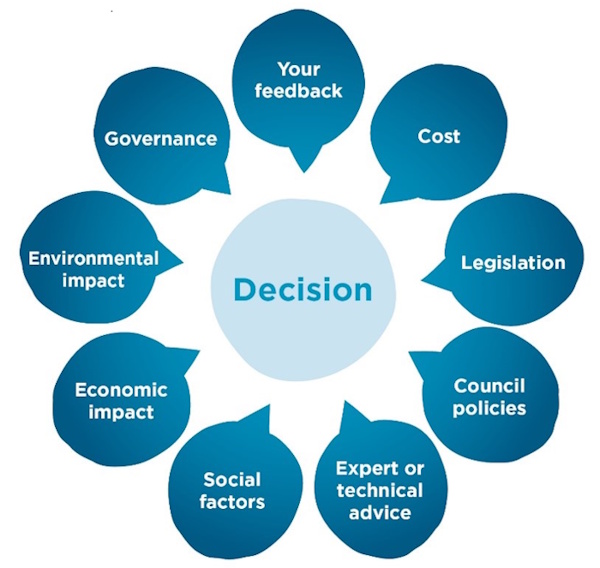
These are some of the factors in Council decision-making:
The City of Wollongong local government area is represented by a Council made up of a Lord Mayor and 12 Councillors. Both the Lord Mayor and the Councillors are popularly elected. This means that they are voted in by people on the Commonwealth electoral roll. The City is divided into three areas called Wards, with four Councillors elected from each Ward.
Find out more information about our Lord Mayor, Councillors and wards.
The Local Government Act 1993 is New South Wales law that sets out Councils’ responsibilities and how they can operate. It also makes sure that Councils engage with their communities.
Chapter 4 of this Act details the ways that community can influence what Council does.
Policies and procedures are the rules and processes we follow. They guide our decision-making, actions and how we direct and control the business of Council. All of Council’s current policies.
If you're d/Deaf, hard of hearing or have a speech impairment, you can contact us through the National Relay Service.
If you need an interpreter, you can contact us through the Translating and Interpreting Service on 131 450. You'll need to provide our phone number 02 4227 7111 when using these services.
Have questions or want to learn more about a project, contact us below:
| Phone | (02) 4227 7111 |
|---|---|
| Website | www.wollongong.nsw.gov.au |
| In writing | Visit 8:30am - 5pm, 41 Burelli Street, Wollongong NSW Australia |